Feeds:
Posts
Comments

Posts Tagged ‘inspiration’

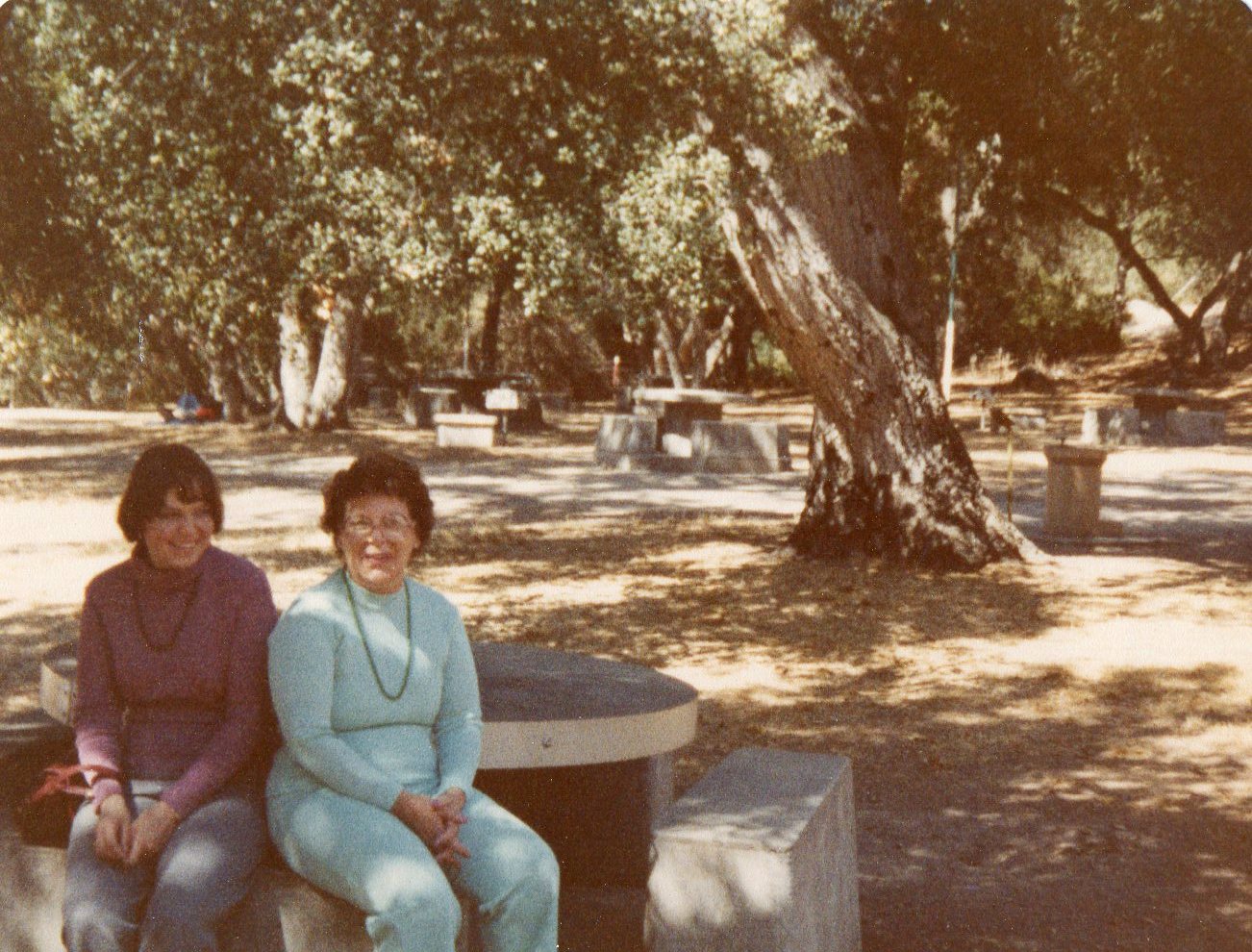
Mom and Me, Picnic

This is my first Mother’s Day without Mom. I miss her, not so much the way she was at the end, when, frankly, she didn’t really know who I was anyway. (Alzheimer’s disease is a far worse villain than anything I can come up with.) I miss her the way we were back in this photo, which is just an ordinary picnic. After Dad retired, they took up the habit of going on picnics once a week, usually on Tuesdays. If the weather didn’t cooperate, they’d still go for a drive and stop to eat somewhere. It didn’t take long before they knew all the best places–indoors or out–within a three-hour drive in any direction. (Well, not west. You can’t drive three hours to the west from here without a boat. ) Whenever I felt I needed a break, I could just throw my name in and join them for a day.

I’m planning to keep myself busy. There’s a lot that needs doing around here and I’m about two-thirds through revisions to MAGIC AND POWER.

Mothers Day Book Bash Banner

Don’t forget the Mother’s Day Book Bash. Nine great books for bargain prices.

And, just to tie the two parts of this post together, Mom was part of the inspiration for Valeriah in the Chimeria series. Not Vallie’s aggressiveness or her fighting prowess, that wasn’t Mom at all. Though, she wasn’t afraid to make her opinion known. No, the part of Valeriah that comes from Mom was the petite ball of fire aspect. Mom was barely five feet tall on a good day, but she sure was a firecracker.

Read Full Post »

THE BARD’S GIFT, of course, is an historical fantasy. I researched the Iceland, Greenland, and the way of life there in the 14th century to get as much of the background of the story right as I possibly could. But the story is mine, not based on anything that really happened.

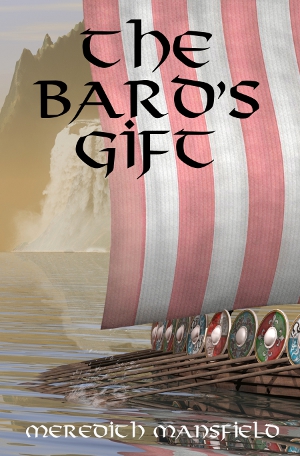
TheBardsGiftCoverSmallThere are other, sometimes less obvious ways, that fantasy and history meet. A medieval setting has become the default for second-world fantasy stories. Of course, some writers do medieval better than others. I still remember my confusion in reading a story in a clearly medievalish setting that nevertheless had private bathrooms with running water. Not that you can’t do that in a fantasy story. Just that you probably should provide some tiny explanation of the change. (Maybe it’s magic.)

The medieval default is so strong that an author has to work a little harder to convince readers that the setting isn’t medieval. I always seem to especially enjoy those stories. They’re like a breath of fresh air. And I’ve written a couple of them. MAGE STORM has a sort of settlement-era setting (like when farmers were first settling in the Ohio River Valley) and at least part of the setting for MAGIC AND POWER is modeled more or less on the desert southwest (without cowboys or the wild west aspects).

Sometimes history provides inspiration, too. In MAGIC AND POWER, I needed a reason for Ailsa’s family to be political outcasts. My inspiration for that was actually the Duke of Windsor, who was forced to abdicate because he married a divorced American woman (although the actual history was somewhat more complicated than that). So, just what do you do with an ex-king? And how would his presence nearby affect the new king? Those questions provide some of the external conflict for MAGIC AND POWER.

Read Full Post »

Where do story ideas come from? Many of the seeds of my stories go so far back that I can’t put a finger on just how they started. THE BARD’S GIFT is not one of those stories. I can trace its development very clearly. Here’s how it happened.

TheBardsGiftCoverSmall

Back in February of 2010, a writing challenge was issued on one of the writers’ forums to which I belong (Hatrack River). This isn’t uncommon. We have several challenges a year. I’ve only entered a few because they’re all for short fiction–often very short–and, well, I don’t write short well. The last thing I started that was intended to be a short story or maybe a novella is now almost 90,000 words long. However, if an idea comes to me, I will give one of these challenges a try, mostly just to stretch myself.

Some of these challenges have a trigger or writing prompt. The trigger for this one was “Slave to the flame” and I came up with a story about the first dragon to learn to breathe fire, initially titled “First Flame.” It was written as a fable.

My story didn’t do very well in the challenge, partly because I killed off the main character (a dragon). There was nothing else I could do in the word-count allowed for the challenge (3,000 words). The voters also didn’t think he was really a slave to the flame.

Freed from the constraints of the challenge, I added some more to the ending which allowed the main character to survive, although badly wounded. But, it was still a fable. So, I created a framing story, about a girl with the gift of telling the exactly right story at the exactly right time. I put her in a desperate situation and let her tell the fable. This version was 5,000 words long, 4,600 of which was the fable.

But, it left me with a lot of questions. How had the girl come by this ability? How had they gotten into this desperate situation? And, of course, what would happen next?

Some of the things in that framing story made me think it was meant to be in a Norse setting, but not in the Norse homeland. So, I did some research and eventually, in 2012, I wrote it as a young adult novel. That original story is still there. It makes up Chapter 36. Here’s a taste:

 Astrid drew a deep breath. “Some dragons can breathe fire. Did you know that? They couldn’t always breathe fire, though. And while some dragons, like Fafnir, are known to be smart, they weren’t at one time.

“It all goes back to the time of Wyreth the Wise. Now Wyreth was small for a dragon. He could do well enough on his own, but he only survived the dragons’ mating season because he was quick and because he was smarter than the other dragons. And maybe because he was stubborn, too.

“When there were many dragons together he was always last for everything. Dragon society is built entirely on who can bully everybody else. If you’re bigger or stronger than the others, you eat first, you get the best and sunniest sleeping spots, and, if you’re a male, you get most of the females come mating season.” She stole a quick look at Torolf under her lashes, here. “Wyreth was the smallest dragon. So he always ate last, had the worst and coldest sleeping spot, and none of the females even looked at him.”

“Whenever Wyreth killed a deer or a pig–cattle were entirely too big for him–one of the other dragons swooped in and stole it from him. The worst offender was Zilthss, Wyreth’s egg brother and the bane of his existence. Zilthss was big and strong, more than strong enough to kill his own prey, but he preferred stealing Wyreth’s whenever he could.

Because he was big and well-fed, Zilthss slept in one of the best spots and his scales were a beautiful burnished copper. All the females turned their heads when Zilthss flew by, even out of mating season. Wyreth’s scales were an unremarkable dull metallic red.”

Several of the children stole a glance at the shiny red scales behind Astrid.

“Because he was quick and smart, Wyreth usually dragged his kill into the dense brush, where the other dragons wouldn’t easily fit and gulped down as much as he could before they powered their way through to steal his meat. Bolting his food like that gave Wyreth indigestion, but it was better than starving.

“Now, at the time of this story, Wyreth had had a particularly bad week. Mating season was about to begin and the male dragons were more than usually belligerent. Zilthss had trailed Wyreth around like a hound on a scent and stolen everything he killed–even the pitiful little rabbit–before Wyreth could get so much as a bite.

“After losing the rabbit, Wyreth flapped off feeling sorry for himself. He had learned long ago that if he flew up the steep slopes of the cone-shaped mountain, the others wouldn’t follow him. There was nothing of interest there, certainly no game to hunt.

These dragons were creatures of mountain forests and no trees grew on the glassy slopes of that mountain, but at the top there was a round, rocky valley where the stones themselves were warm, even at night. Since Wyreth couldn’t get any of the warm, sunny sleeping spots in the rookery, he’d taken to coming up here. The sun was strong, but the heat from the ground was stronger still and comforting.

“That is, it was usually comforting, but not today, because Wyreth’s stomach was so empty. Even the warm rocks and the sun on his spread-out wings couldn’t ease Wyreth to sleep when his stomach growled so loudly. In desperation, Wyreth chewed on the yellow rocks. The yellow ones were much softer than the shiny black ones; a dragon could break his teeth on those. Some pieces of the yellow rock were small enough to swallow. Not exactly nourishing, but at least it filled up that hollow feeling inside for a while, though Wyreth suspected that they would be the very devil to pass. Well, that was tomorrow’s problem. Wyreth stretched himself out on the heated rocks and slept.

“He woke with a mighty belch. That wasn’t unusual for Wyreth. What was unusual was the gout of blue flame that leapt from his mouth along with the burp. Wyreth back-winged in surprise.”

Several of the older boys laughed at this. The younger ones giggled uncertainly. The oldest boy essayed a burp of his own and that sent the little ones into gales of laughter. Astrid glanced up from the children. Several of the men had looked over at the sound of laughter. Torolf was watching her. Astrid smiled and went on with her story.

Read Full Post »

THE BARD’S GIFT officially launches on January 30th. (Actually, you can get it now on Amazon, though.)

TheBardsGiftCoverSmall

Here’s another fun fact and excerpt.

You never know what your research will turn up–or how you’ll end up using it. In this case, I was looking for fish that one of my characters might reasonably be fishing for–and found the Greenland shark. It’s a real creature.

The Greenland shark lives farther north than any other shark species. They are comparable in size to the great white shark, averaging ten to sixteen feet in length and up to 900 pounds. They can grow as large as 21 feet and over 2,000 pounds. Usually only found near the surface only during the winter, they are otherwise denizens of the deep. They have been found with parts of polar bears in their stomachs.

The flesh of the Greenland shark is poisonous, but the hardy Icelanders (and presumably the Greenlanders), had a way of leaching the poison out. Of course, it still smelled overpoweringly of ammonia, even then.

This was too good not to include in the story, especially the bit about possibly eating polar bears. Here’s an excerpt from Chapter 7 of THE BARD’S GIFT (a faering is a small fishing boat with both oars and sail) This excerpt also happens to include their first kiss:

Torolf pushed the skiff down the strand and into the water and jumped aboard. The faering had four oars, meant for two men, but Torolf had changed the rigging of the sail to make it easier for one man alone to manage the steering oar and the sail. He hadn’t had a chance to try that innovation out yet. The wind was in the wrong direction right now, but maybe he’d get a chance to test it on the way back to shore.

It didn’t take long to row out to where he judged the water was deep enough. He threw a half dozen lines over the side and began casting a net for whatever fish might be nearer the surface, stopping after each cast to watch the shore for Astrid.

He’d pulled in several nets full of herring when one of his lines jerked sharply. Torolf dropped the net into the bottom of the skiff to pull in the line. Whatever he’d caught was heavy. He didn’t think he was far enough out for halibut this large, but he couldn’t think of many other fish in these waters that would be so heavy. He continued to pull, muscles straining. Abruptly, the pressure on the line ceased and the fish–or what was left of it–flipped into the boat practically on top of Torolf. It had been a halibut all right, and a big one. Two thirds of it was missing, now, though.

Torolf stared at the ragged bite mark. Only one predator could have made that–a Greenland shark. And it’d have to be a big one to take most of a fish that size in one bite. He looked over the side of the boat and just glimpsed the sleek form below, almost half again as long as the boat. Not the biggest, but more than big enough. Unusual for it to be in this part of the fjord at this time of the year.

Torolf made a face at the thought of shark meat. The flesh of a Greenland shark was poisonous. It had to be fermented and pressed and then hung to dry for several months before it could be eaten. Even then, it smelled strongly of ammonia. Still, kaestur hakarl made in that way would be food for midwinter. By then everyone would probably be willing to overlook the smell and taste just to have a full belly. Looked at that way, the shark represented a lot of meat.

Torolf looked over the side again. No. This was a disadvantage of fishing alone; the shark was much too big for one man in a small boat to bring in. With that one swimming below his skiff, he wasn’t likely to bring in anything on any of his lines, either, so he began to haul them in. Better to go in, now, anyway. He’d heard stories of large Greenland sharks attacking small boats. With his faering half full of herring, there was no need to risk it. The wind was favorable. Now might be a good time to see how the skiff handled under sail.

He’d just gotten the sail up when he heard a shriek. Torolf turned toward the sound and saw Astrid pelting down the rocky beach, her white bear pelt cape flapping behind her. A huge ice bear galloped after her, fifty paces behind Astrid and closing fast. Torolf turned the tiller and set the faering racing toward Astrid.

The skiff was fast under sail, but no human could outrun a bear for long. Torolf shouted, “Astrid! Over here!”

Astrid looked up without breaking stride. She turned, almost slipping on the slick rocks and dove into the fjord. Her woolen dress and the heavy bear pelt immediately started to drag her down. The look on her face was even more panicked. She couldn’t swim? Of course she couldn’t. Few enough of the men could do more than tread water if they fell overboard. And that not for long in water as cold as this. Torolf steered the faering as close into shore as he dared and leaned far over to grab Astrid and pull her in.

The bear leaped into the water, too, with a splash that rocked the small boat. Torolf turned the sail and grabbed the steering oar to drive the faering back out into deep water. Not that that would be much help. He had no weapon aboard that he could hope to kill a bear with. An ice bear could swim the width of the fjord without difficulty, but an idea came to Torolf to pit one predator against another. He pulled the steering oar over a little farther to steer back to the same place where he had been fishing a moment ago.

Astrid struggled off the pile of slippery herring she’d landed on and took up a pair of oars. Her strokes were nowhere near as expert or powerful as Torolf’s, but they added to the skiff’s speed, nonetheless. As she got the rhythm, she started to pull for the home shore, where the larger boats were still pulled up on the sand.

“No,” Torolf shouted, pointing to the course he wanted. “That way. Trust me.”

Astrid paused just an instant, then she started rowing in the direction Torolf indicated.

Torolf looked back. The bear was persistent. Though the skiff was racing ahead of it, the beast still swam after them. Torolf looked ahead. They’d almost made it to the spot where he’d last seen the shark. He turned again at a furious roar close behind. The bear struggled and the water around it turned from green to red. Then the bear disappeared beneath the waves and didn’t come up again.

Astrid looked around as if she expected the bear to surface right beside them. “What happened?”

“Greenland shark. About the only thing big enough to eat an ice bear.” Torolf turned the sail and let the faering skim toward home.

The ripples of the bear’s submersion subsided. After a moment, Astrid smiled and they both erupted into gales of relieved laughter.

“What did you do to that bear?” Torolf asked when he could draw enough breath. “Walk up and tweak it’s nose.”

Astrid giggled. “No. I found a seal carcass back there. I was just going to cut off as much as I could carry with me when that bear charged down the slope and chased me off.” She plucked at the sodden bear pelt. “I think he thought I was a rival.”

“Maybe he did.” Torolf slowed the faering. “Maybe we should go back and bring in as much of that seal meat as we can. The skiff can hold quite a bit more.”

“Maybe we should.” Astrid shivered.

Torolf set the faering back toward home. “No. First you need to get warm and dry. Pa and I can go back for the seal meat. Can’t have you getting sick before we set sail for Iceland.”

Astrid ducked her head, her smile disappearing. “I guess that would be best.” She looked out over the side at the water slipping away beneath them.

Torolf watched her for a long moment. “Astrid . . . I was going to wait until we reach Iceland. Where the distance between us–poor farmer’s son and chieftain’s daughter–won’t be as great. Until I can find work and a place of my own to live. But that might take me a while and you’re so beautiful and brave. By then someone else may start to court you.” He was babbling. He paused, drew in a deep breath, and resolved to just blurt it out. “Astrid, will you be my . . . uh . . . sweetheart?”

Her eyes widened and her breath caught. Astrid stared back at Torolf. He decided that the look on her face was definitely not displeased, though. Greatly daring, he leaned forward and kissed her briefly.

When he pulled back, Astrid put her hand up to her mouth.

By her eyes, though, he could tell she was smiling. “Should I take that as a yes?”
Read Full Post »

In researching the Greenlanders for THE BARD’S GIFT,

TheBardsGiftCoverSmallof course I ran across their legends about sea monsters. One of those monsters was hafgufa.

Translated as “sea mist” or “sea reek”, hafgufa was a sea monster of the Greenland Sea between Greenland and Iceland. Hafgufa was supposed to lie on the surface to feed. The stench of its belch drew in fish, which the hafgufa would then consume, along with anything else in the vicinity, including ships. Only Orvar-Odd had ever escaped, because he knew the beast rose and submerged with the turn of the tides and was able to get his ship out of range just in time.

Hafgufa was usually seen as only a pair of rocks said to be the beast’s nose. Sometimes hafgufa was equated with the kraken. Others attribute the stories of hafgufa to underwater volcanic activity and the release of methane gas.

Here’s an excerpt from Chapter 20 of THE BARD’S GIFT. To set the scene: it’s foggy and Torolf is alone in a small boat (a faering, 0r small fishing boat). A few strange phenomena (attributable entirely to deep ocean volcanism, not sea monsters) start his imagination running wild.

Torolf paused, lifting the oars out of the water. He was closely tuned, now, to the background noises of the sea around him. He’d swear he’d heard a sound that didn’t fit. There it was again. A sort of gurgling noise that wasn’t like anything he’d heard at sea before. A whale diving? No, he’d heard that before and it didn’t sound like this. In fact, more than anything else in his experience, this sound reminded him of a kettle on the boil–which made no sense at all.

The skiff rocked as a wave struck its side. That was wrong, too. The waves should be following from behind the skiff. It wasn’t a storm wave; there was still no wind to speak of. The wave came from the same direction as the strange sound.

The air moved slowly in this fog, slower than sound, so the stench reminiscent of rotten eggs reached Torolf last. Magni’s wild stories about hafgufa came back to him at the same instant. They didn’t seem so wild right now.

Sweat ran down his face despite the clammy fog and his pulse raced. What now? The only thing he could think of was that the monster only surfaced at the turn of the tide and stayed on the surface until it turned again. Orvar-Odd had sailed through safely because hafgufa had just surfaced and he had time to get out before it submerged again, sucking everything in the vicinity down with it. It wasn’t so easy to determine the turn of the tide out here in the open ocean. When had it turned?

He clutched the oars hard. Did it matter? He could hope at least that the splash he’d heard was the creature surfacing. Well, obviously. Otherwise, he’d already have been sucked down with the monster. So, his only hope was to get as far away as he could before hafgufa submerged.

Torolf drove the oars into the water so hard he almost lost control of them. He drew a deep breath and set up a steadier rhythm as fast as he thought he could maintain.

After what felt like hours, but was probably little more than one hour, he had to stop to rest a little and eat something, especially to drink water. He flinched at every sound or slightest movement. The fog seemed a little thinner and he thought he felt a breath of air. He hoped that wasn’t only wishful thinking. Being able to raise the sail was his only hope of making real distance. The faering could almost fly over the water with enough wind to fill its sails.

Another gurgle sounded off to his left and Torolf grabbed up the oars again, pulling for all he was worth. He rowed until he thought his heart would burst. When he couldn’t row another stroke, he shipped the oars and sagged against the gunwale, breathing heavily. His throat felt like he’d tried to swallow sand and his shoulders burned. He fumbled for one of his precious water skins and drank deeply.

He wasn’t far enough. Not nearly far enough. He was sure of that, but he couldn’t row anymore. Not to save his own life. A breeze ruffled his hair and cooled his sweaty face. Torolf looked up. The fog had lifted and he’d been too intent on rowing to even notice. The breeze ruffled his hair again. He lifted the little pendant that had been his mother’s, halfway between a cross and a Thor’s hammer, to his lips. It wasn’t a strong wind, but it was enough to put up the sail. He could rest for a while and still keep moving.

Torolf raised the sail, forcing his aching arms to the task. Then he collapsed in the bottom of the boat, too tired to move another muscle.

Read Full Post »

Writing THE BARD’S GIFT

TheBardsGiftCoverSmallwas a different experience for me. I write fantasy. Usually, I just get to make things up (as long as it makes sense, anyway). That’s why they call it world building. But THE BARD’S GIFT is historical fantasy, so I couldn’t just make up anything I wanted. I had to do research to find out what kind of houses my characters would live in and what kind of clothes they’d wear and a bunch of other things.  Sometimes, interesting things turned up in this research. Some made it into the story, some didn’t.

Now, since my Norse characters go to set up a new colony in North America (in what the Greenlanders would have called Markland, around the Saint Lawrence River) I also included some things specific to North America–especially the thunderbird.

Many North American Indian tribes had stories about Thunderbird. For some, it was a singular, somewhat irascible, creature and a sometimes guardian. In the Pacific Northwest, there were said to be many thunderbirds, who could remove their feathers like a cloak and tilt their beaks up like a mask and so take human form. Those things made it into the story.

What didn’t get in was the real-life (prehistoric) birds that might have been inspiration for the Thunderbird. These teratorns, something like a cross between a condor and an eagle, actually once flew over the skies of North (and South) America.

Merriam’s Teratorn is well known from the Rancho La Brea Tar Pits. It would have weighed about 30 pounds and had a wingspan of about 10 to 11 feet. That’s a big bird.

But it’s nothing compared with it’s cousin Aiolornis Incredibilis, which weighed in at 50 pounds and had a wingspan of 16 to 18 feet. Yikes! How’d you like to see one of these fly overhead?

And both of these birds would have been in the skies when people first arrived in the New World.

The biggest of all is only known from South America. Argentavis Magnificens was the largest known flight-capable bird (though it probably soared much more than it flew). It had a 25-foot wingspan and would have weighed about 170 pounds! One of its flight feathers would have been 59 inches long (that’s almost six feet!).  (Sorry, five feet, not six. I shouldn’t try to do arithmetic in my head before breakfast.) Now that’s a Thunderbird.

I’m not making this up. Just take a look at the first chart on this site.

More fun and interesting things to come as we lead up to the launch of THE BARD’S GIFT on January 30th.

Read Full Post »

Not me. My writing is going pretty well right now. In fact, I’ve just about finished this draft of THE SHAMAN’S CURSE. I’ll let it rest a while and then give it another go through before handing it over to beta readers in February.

No, in this case, I’m writing about the bane of this time of year–burnt out Christmas (or other holiday) decorations. Things that should light up, but don’t. I’ve been particularly plagued this year. But it’s nothing I haven’t dealt with before. So, I’m going to depart from writing for this post to show you how I deal with it.

For example, this:

Reindeer Topiary

used to be a lighted reindeer lawn ornament. But then the light-strand burned out. And, of course, it wasn’t just a straight lightstrand that I could replace. So, after a little thought, I stuck the legs into some potting soil in a rectangular pot (which I happened to already have) and planted ivy at all four legs. It needs another year to really fill in, but it gave the old lawn ornament a new life.

This year, I’ve got two more outdoor ornaments that have partially given up the ghost. (Not to mention having to use a separate light strand to patch a gap in the pre-lit Christmas tree. But that’s easy.)

Spiral Tree

This one has decided that only the upper two-thirds will light this year. It’s going to be fairly straight forward to deal with, though. It also has a ground stake in addition to the patio stand currently in use. I’ll use another one of my unused pots, the ground stake,  and probably another ivy to grow up the spiral support. It’ll take a couple of years to reach the top, but I won’t have to go out and buy another one. (Not that I think you can even find these anymore.) Reduce, reuse, recycle.

This one:

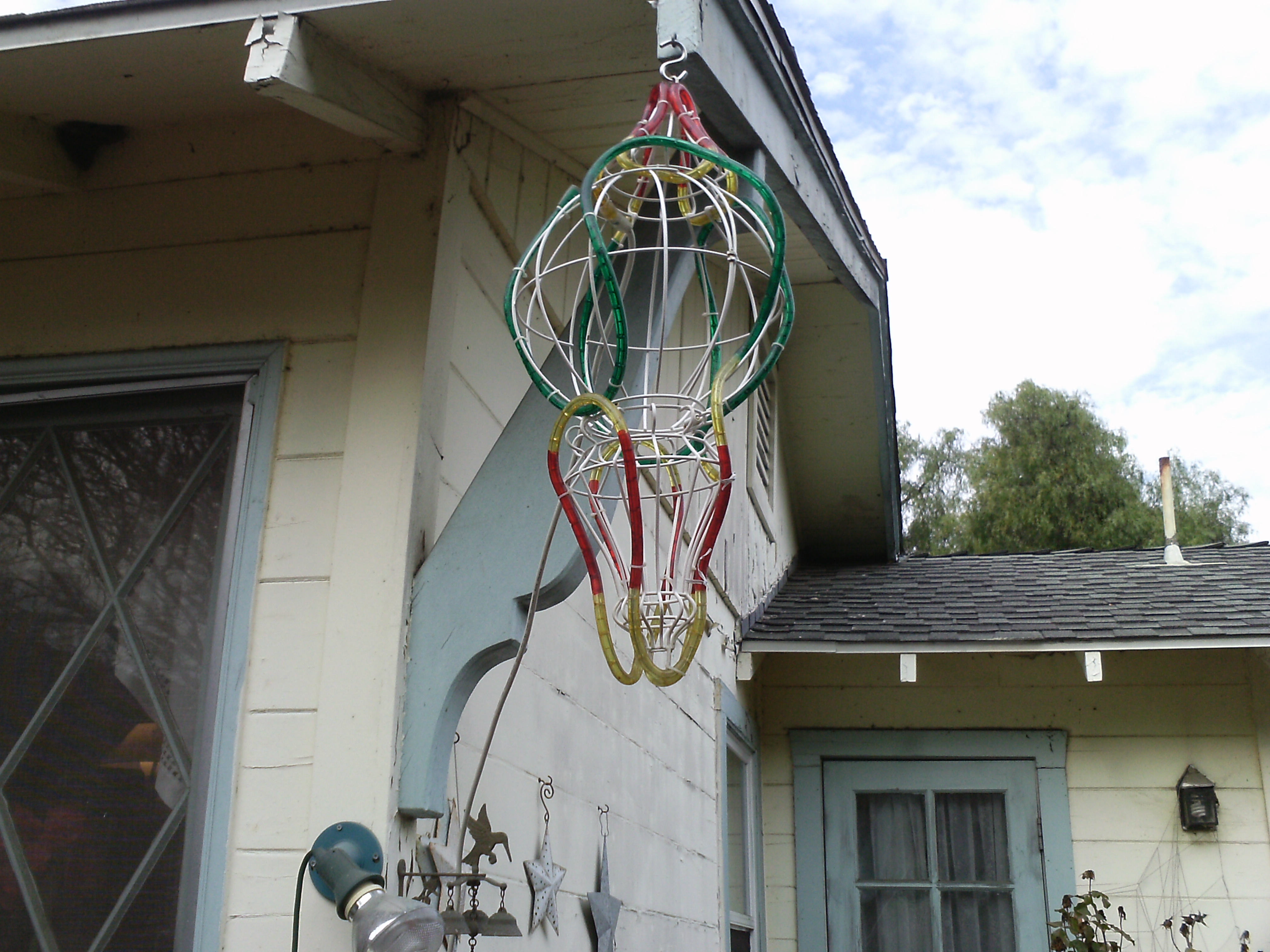
Lighted Ornament

Is going to take a little more thought. The middle portion won’t light up this year. Right now, I’m thinking along the lines of a sphagnum moss hanging basket, but I’d have to choose the plants really carefully. Even here in Southern California, there aren’t that many things that bloom in December. Maybe foliage plants. Hmm. I wonder if there’s a ground cover form of holly.

Never give up. There’s always some way around any difficulty. Come to think of it, that’s pretty good advice for writers, too.

Merry Christmas.

Read Full Post »

I probably should be writing a mentee bio for Pitch Wars, but . . . well, that’s not really the kind of writing I’m best at–writing about myself–and, anyway, I feel that I’d like my story to stand on its own. Still, fingers crossed for MAGE STORM everyone.

Instead, I’m going to write about using stories as an escape. It’s one (only one) of the primary purposes of fiction–to take us away from our day-to-day lives and problems for a little while.

This post was inspired by a quote by Dorothy L. Sayers (who wrote the Lord Peter Wimsey mysteries) I read somewhere:

Lord Peter’s large income… I deliberately gave him… After all it cost me nothing and at the time I was particularly hard up and it gave me pleasure to spend his fortune for him. When I was dissatisfied with my single unfurnished room I took a luxurious flat for him in Piccadilly. When my cheap rug got a hole in it, I ordered him an Aubusson carpet. When I had no money to pay my bus fare I presented him with a Daimler double-six, upholstered in a style of sober magnificence, and when I felt dull I let him drive it. I can heartily recommend this inexpensive way of furnishing to all who are discontented with their incomes. It relieves the mind and does no harm to anybody.

It’s pleasant to share time–either writing or reading–with a character that doesn’t have to worry about the same things we do. As a writer, I have more scope for this than my readers. I get to spend more time with the characters as I write and revise the story than readers ever will. Plus, I get to determine the backgrounds–privileged or impoverished–from which my characters come.

Of course, those characters do have to have problems or there isn’t much of a story. This wasn’t too much of an issue for Lord Peter, because his problem was almost always a mystery to be solved. Only a few times did those mysteries really impinge on his life.

For other kinds of stories–quests, for example, which are common in fantasy and even some science fiction–that won’t work. We have to put the characters in real danger, chase them up trees and throw rocks at them.

But, you know, even that is a kind of escape. Going along, from our safe arm chairs, on hair-raising adventures or romantic adventures, takes us out of the here and now temporarily. Some days, we all really need that. 

Good thing those stories are fun to write, too, isn’t it?

Read Full Post »

Tomorrow’s Thanksgiving. Lots to do.

But, I’ve been thinking about something lately, so I’ll talk about it here. I’ve recently finished (yesterday, as a matter of fact) an interesting indie book (FLEDGLING by Nicole Conway). This made me think of the prevalence of orphan and/or abused and/or seriously misunderstood protagonists, especially in middle grade/young adult stories.

Harry Potter immediately comes to mind, of course, but he was far from the first. Anne McCaffrey’s Menolly in the Harper Hall trilogy. Taran in Lloyd Alexander’s Prydain Chronicles. Even Luke Skywalker in the original Star Wars trilogy. I could go on and on. The trope of the orphan boy or widow’s son who makes good goes all the way back to fairy/folk tales.

And it made me wonder. Why? Why do so many stories start with this kind of hero? I think there are several reasons.

For one, at least as far as middle grade stories are concerned, I think we all go through a period around those years when we believe no one understands us. It’s something the readers can relate to, at least as far as the misunderstood protagonist goes.

Another reason might be that it builds in some initial conflict while the story gets started. While the narrative is building to the inciting incident, the character already has something to fight against. And it can even be a further complication–something, perhaps, that makes the hero doubt himself–once the real story problem is in full tilt.

But sometimes I think it’s just done to build sympathy for the main character, like having him pet the cat. And that just makes me want to break type. Someday, I’m going to have to write a story in which the orphan is bitter and becomes the villain. Just because I can.

Happy Thanksgiving Everyone.

The First Thanksgiving, painting by Jean Louis...

The First Thanksgiving, painting by Jean Louis Gerome Ferris (Photo credit: Wikipedia)

Read Full Post »

Sometimes, it’s surprising what things will come together at the precisely right time to spark an idea. That might be the seed of a new story. Other times it might be the germ of what needs to happen to make an existing story better.

That happened to me yesterday. I was working through one of the critiques on MAGIC AND POWER (which may be retitled DESERT ROSE). Then I read this post on Adventures in YA Publishing, and everything started to come together.

I had a period early in my story in which my main character didn’t seem to be struggling enough. There wasn’t enough tension. Also, during that part of the story, the hoped-for love triangle didn’t have as much suspense as it needs because the “right” choice was a little too obvious.

Now, I’m going to give that “right” choice some drives based on his background that are at odds with the main character’s desires. Basically, he’s going to annoy the heck out of her, causing her to brush off her early attraction to him.

I think it will make the story so much better. And that’s the name of the game.

Read Full Post »

« Newer Posts - Older Posts »